"I thought my work was done. I was wrong. Once more, I must venture into the fray. By recruiting enemies of the state, we arm those who have been disarmed by the Borgia. The greed, the corruption, the tyranny my enemies have spread will burn to the ground. From the ashes of vengeance, a new Rome will rise."
―Ezio Auditore da Firenze, Assassin's Creed: Brotherhood Launch Trailer.
A sequel for Brotherhood was announced in May 2011, entitledAssassin's Creed: Revelations, and was released in November of the same year.
"I did not choose this path. It was chosen for me. At first, I thought vengeance would be easy. For thirty years I've lived in the shadows, visited death upon those who deserved it, and vanished like the wind. I don't know who started this conspiracy, but I know who will end it. My name is Ezio Auditore da Firenze. Like my father before me, I am an Assassin."
―Ezio Auditore da Firenze, Assassin's Creed II Launch Trailer.
Assassin's Creed II is a sandbox style Action-Adventure video game developed by Ubisoft Montreal and published by Ubisoft. It was released on November 17, 2009 (US), November 19, 2009 (AU) and November 20, 2009 (worldwide) on PlayStation 3 and Xbox 360. The PC version was released on March 6, 2010 (UK) and March 9, 2010 (US).
A direct sequel to Assassin's Creed, the game focuses again onDesmond Miles after he escapes from Abstergo Industries with the help of employee Lucy Stillman. In an attempt to thwart Abstergo and the modern-day Templars, Desmond uses a new Animus to relive the genetic memories of his ancestor, Ezio Auditore da Firenze, who lived in Italy during the Renaissance. The player controls Desmond to a degree, but primarily Ezio, who becomes an Assassin after his family is betrayed. While controlling Ezio, the player can explore renditions of major Italian regions and cities through a mixture of action, stealth, and economic gameplay.
Assassin's Creed II is similar to its predecessor in many ways. The game is non-linear, and can be considered a "sandbox" type of game due to the player's ability to freely roam the generated renditions of Italy. The Animus is replaced with the Animus 2.0, which, unlike the first, possesses an in-game database with historical information about encountered landmarks, characters, services, and glyphs.
Eagle Vision has been updated to allow for third-person view, which can be used while the character is moving. A young version of Leonardo da Vinci is also included in the game and translates Codex pages left behind by Altaïr, allowing for weapon upgrades. Other weapons, such as swords, daggers and maces can also be purchased throughout the game due to the economic system. Navigation has also been altered for the better in that the player is now also capable of swimming, using gondolas and riding horses, as well as Leonardo further contributing to gameplay with the inclusion of his flying machine in one of the game's missions.
A new economic system allows the player to profit from city renovations and upgrades.
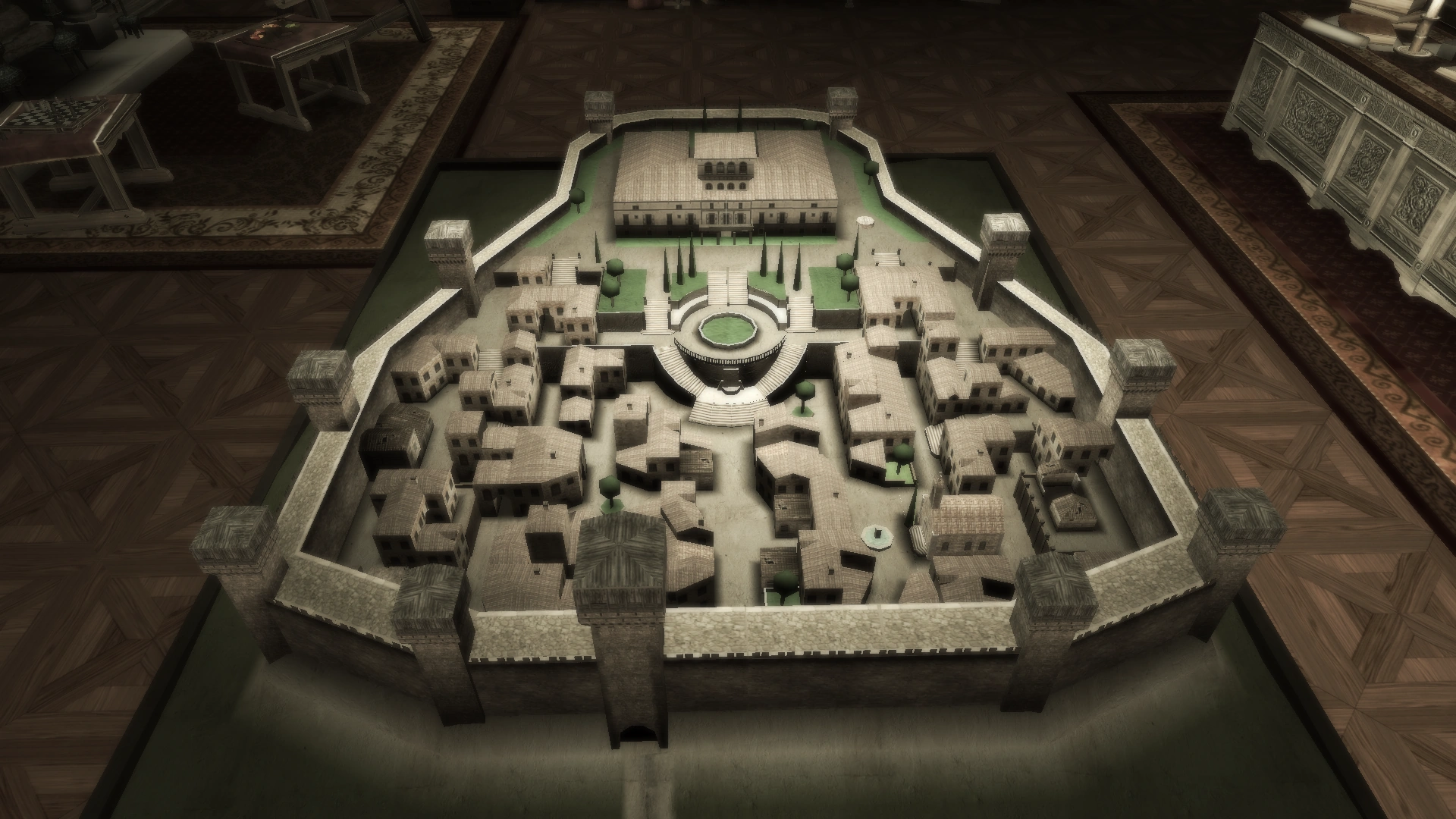
In Monteriggioni, the Auditore family's villa acts as Ezio's primary headquarters throughout the game, and a new economic system allows for the property to be upgraded and enhanced, creating income for the player at twenty minute intervals. As shops within Monteriggioni are renovated and upgraded, Ezio receives discounts on the particular goods that are sold, and income is also affected by the purchase of paintings, armor and weapon sets, along with the collections of various items. Such items are displayed throughout the villa as they are accumulated, and Ezio's personal room is updated with portraits of his assassinations as the game progresses.
The combat system for the game has been updated and allows for further options, including disarming opponents. There are also more methods of hiding, such as diving underwater to break an enemy's line of sight with Ezio, along with blending being improved to be performed with any small group of individuals rather than with specific people. Further along the game, Ezio is capable of learning new methods of assassination, such as ambushing individuals when hiding in haystacks or pulling individuals off buildings to fall to their deaths. Accompanying this, there are several new types of enemies, some more agile or stronger than others. As well as this, Ezio can use smoke bombs and hire groups of thieves, courtesans, or mercenaries to aid him in covering his tracks and avoiding contact with guards. Health in the game is measured via synchronization, and minor wounds will heal automatically over time, while major wounds must be healed by side-street doctors or with medicine purchased from them.
One new feature includes a new system known as notoriety, which, depending on his behavior, current location, and current mission, Ezio will become more recognizable by citizens of the city, specifically guards. When the notoriety icon is empty, Ezio is known as "incognito" and may travel through the city as he pleases. As the player behaves in more "socially unacceptable" ways or due to the consequences of a particular mission, the player will become more noticeable by the guards and more likely to be pursued by them. Notoriety can be decreased by bribing city heralds, assassinating corrupt city officials, and removing wanted posters. The level of notoriety is set within each city, so that while the player may be completely unknown in some cities, he may be infamous in others.
Like its predecessor, the game features the same ability to climb buildings and perform Leaps of Faith into haystacks and carts of soft materials, including herb and spice carts. Climbing has been updated to allow Ezio the opportunity to learn to leap while climbing, allowing him to reach higher positions previously unavailable.
Ezio scaling a building in Florence during nighttime.
A day and night cycle has been added to the game and the player will notice the sun rising and setting throughout gameplay. In addition, specific missions and game events occur at certain times of the day and night.
Due to complaints of some of the missions in the original game, the mission system has been expanded and structured a little differently. There is approximately 200 missions in the entire game with roughly half of them being relevant to the primary storyline. Side quests include the location and search of hidden areas which upon exploration and successful completion will reward the player withseals of past Assassins. On the full collection of the six seals, the player will be rewarded with the armor of Altaïr.
The game also possesses a system mildly similar to the "glitches" from Assassin's Creed, where pressing a specific button during a cutscene will produce specific changes and actions within the scene.
"Jerusalem, the twelfth century. Amidst the chaos of the Third Crusade, a Brotherhood of warriors rose to power. Shrouded in secrecy, feared for their ruthlessness, they alone would save the Holy Land, or destroy it. They were the Assassins."
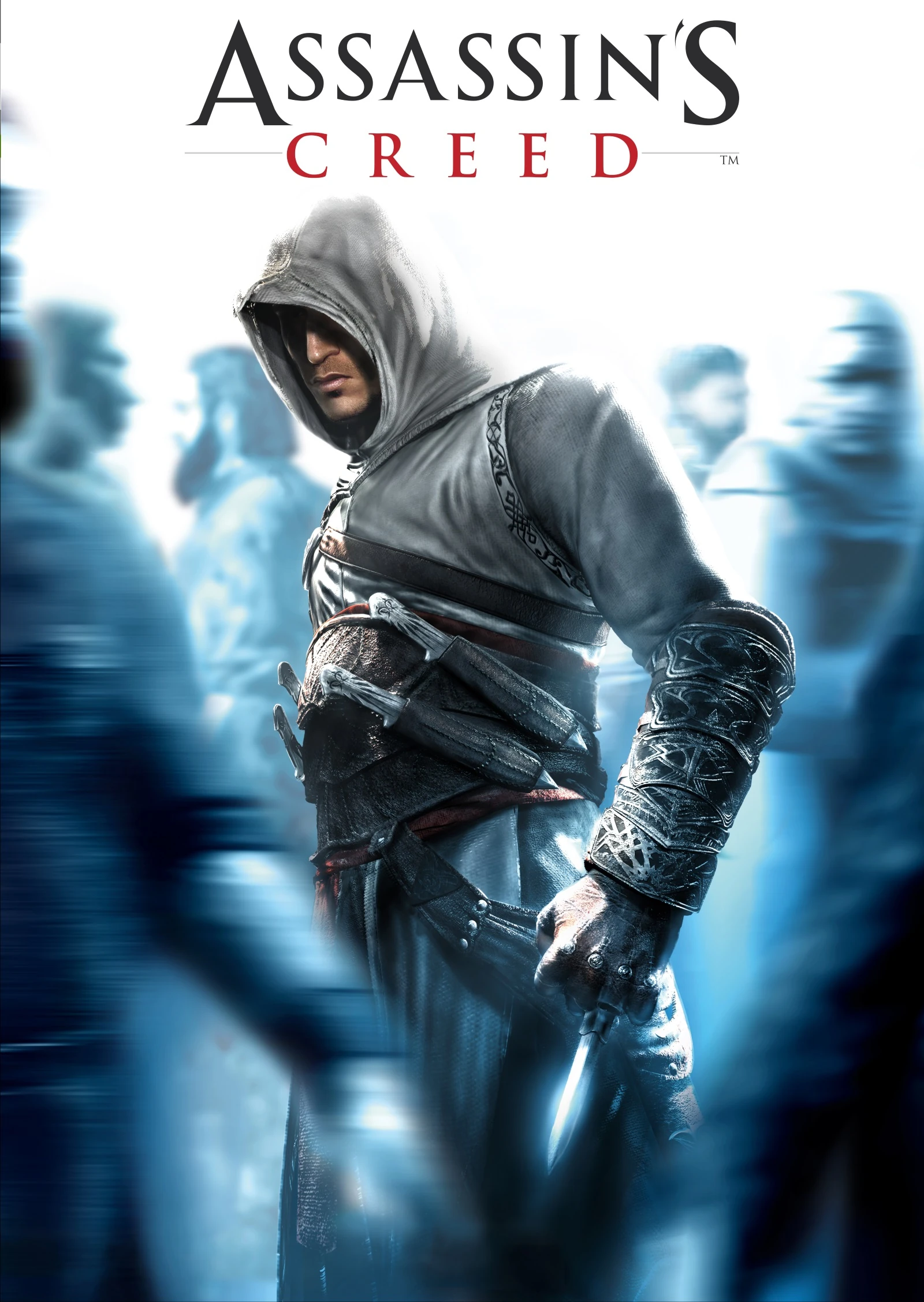
Assassin's Creed is a sandbox style action-adventure-stealth video game developed by Ubisoft Montreal and published byUbisoft. The game was released for the Xbox 360 and PlayStation 3 in November 2007 and for PC in April 2008.
The game centers around the use of a machine dubbed "The Animus", which allows its user to view the genetic memories of his or her ancestors, specifically a bartender named Desmond Miles. As Desmond relives the memories of one of his ancestors, the Assassin Altaïr Ibn-La'Ahad who lived in the Holy Land during the Third Crusade, details of a battle between two ancient sects, theKnights Templar and the Assassins, emerge as both scour for an artifact known only as a "Piece of Eden".
The game received primarily positive reviews, for both its story and its gameplay, and received several awards at the 2006 E3. In November 2009, Assassin's Creed II was released as a sequel.
Upon arrival in any of the cities, Altaïr must locate an agent of the Brotherhood (called a Rafiq) who will provide a safe house (the Bureau) and basic knowledge of the target. It is up to Altaïr to perform additional intelligence gathering via eavesdropping, interrogation, meeting with informers, and gathering important items. It is only after Altaïr has gathered enough information that he can carry out the assassination. After successfully completing an assassinations, Altaïr returns to Masyaf, and is rewarded with a better equipment, then given the names of his next targets.
High vantage points allow the player to map out portions of the city.
While performing the necessary missions, Desmond must direct Altaïr to high points in the city to further synchronize the memories which maps out the city that he is currently located in. Other side quests include tracking and killing Templars, flag collecting, and saving citizens who are being threatened by city guards.
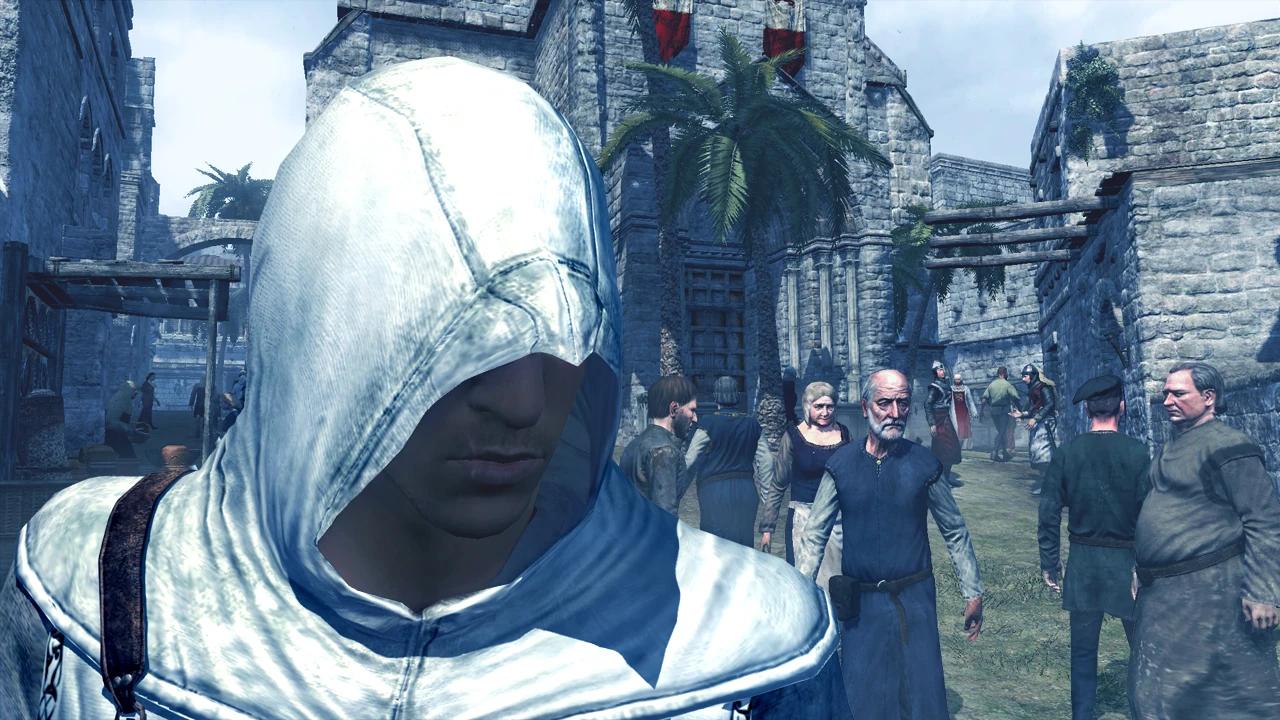
Altaïr needs to carry out most of his missions without being noticed by officials. The game uses the Alertness Level Meter to inform the player of how noticeable Altaïr is to the surrounding individuals, including the guards, by changing the color and shape of the Abstergo Logo. Performing certain actions at certain times may or may not raise the local area's awareness level. If an area is on high alert (the logo becomes red, and the entire sync bar earns a red tinge and background), all citizens will run and scatter in various directions as guards chase and attempt to bring down Altaïr, and are always on alert. To reduce the alertness level, Altaïr must break the guards' line of sight, find a hiding place or blend in with wandering scholars (who coincidentally are dressed similar to Altaïr) or with citizens sitting on benches.
Altaïr's freerunning abilities allow for greater exploration.
To conduct many of the assassinations and various other tasks, Altaïr is capable of both high and low profile commands, both of which affect the alertness level. Low profile commands will allow Altaïr to blend into crowds, hide, and use Altaïr's hidden blade to attempt quiet and low profile assassinations. High profile commands increase alertness at a greater level and include free running, attacking foes, and high profile assassination attempts. And, should the player find himself faced with multiple enemies, one can utilize Altaïr's sword-fighting abilities.
Health in the game is measured as the level of synchronizationbetween Desmond and Altaïr's memories. When Altaïr is injured, it is experienced as a deviation from the actual memory that occurred and synchronization decreases. If there is complete de-synchronization, the current memory that Desmond is experiencing dematerializes and restarts at the last checkpoint. If complete synchronization is obtained, Desmond, as Altaïr is able to use "Eagle Vision", which has the Animus highlight all visible characters in the current setting in specific colors depending on their status (friend, foe, target).
Because Altaïr's memories are being rendered by a computer, "glitches" may often be experienced with nucleotides and error messages appearing. Such glitches can be used to help identify targets and if the player reacts quickly enough, may be used to provide other vantage points during the cut-scene.


 Added by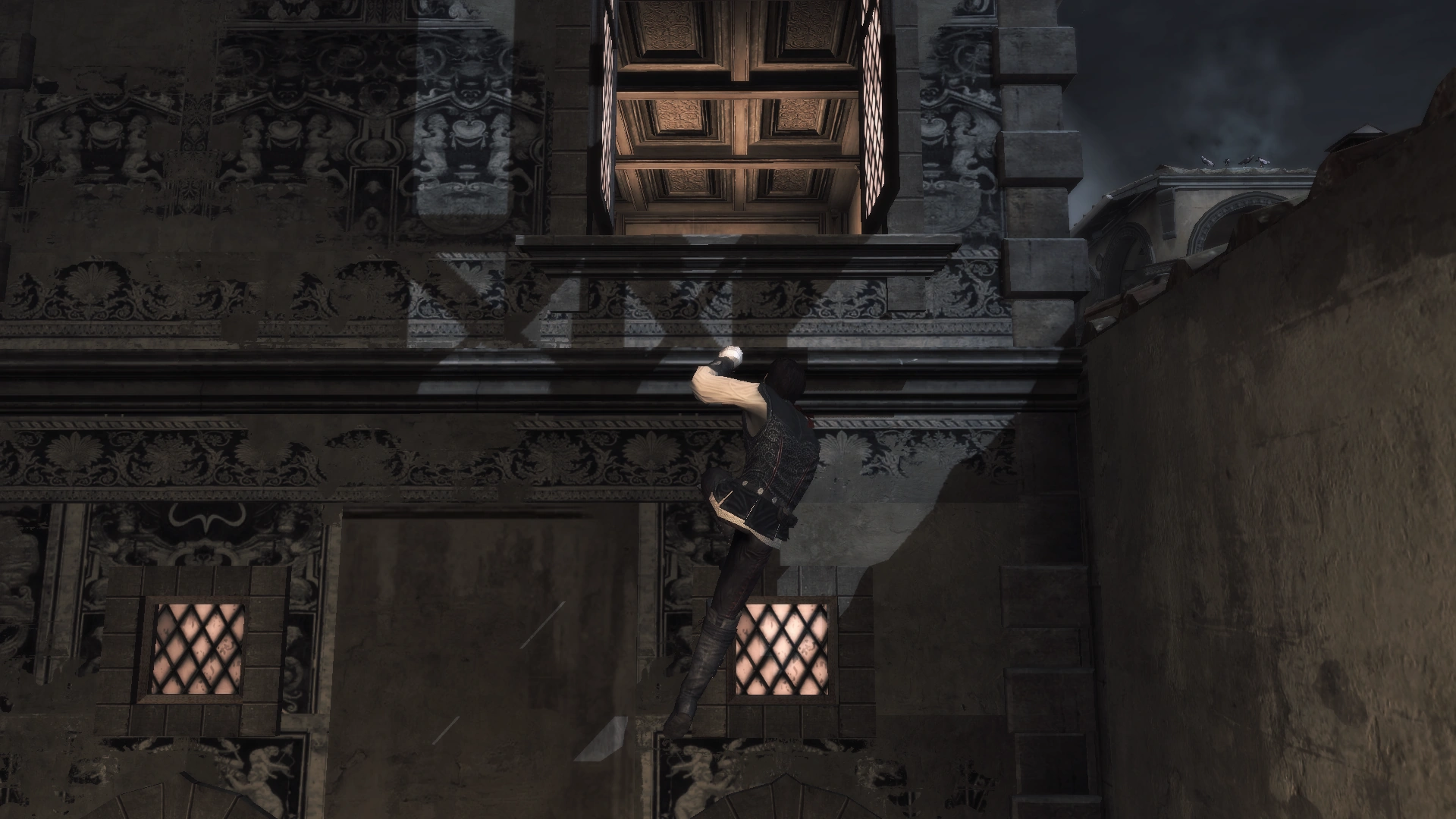
 Added by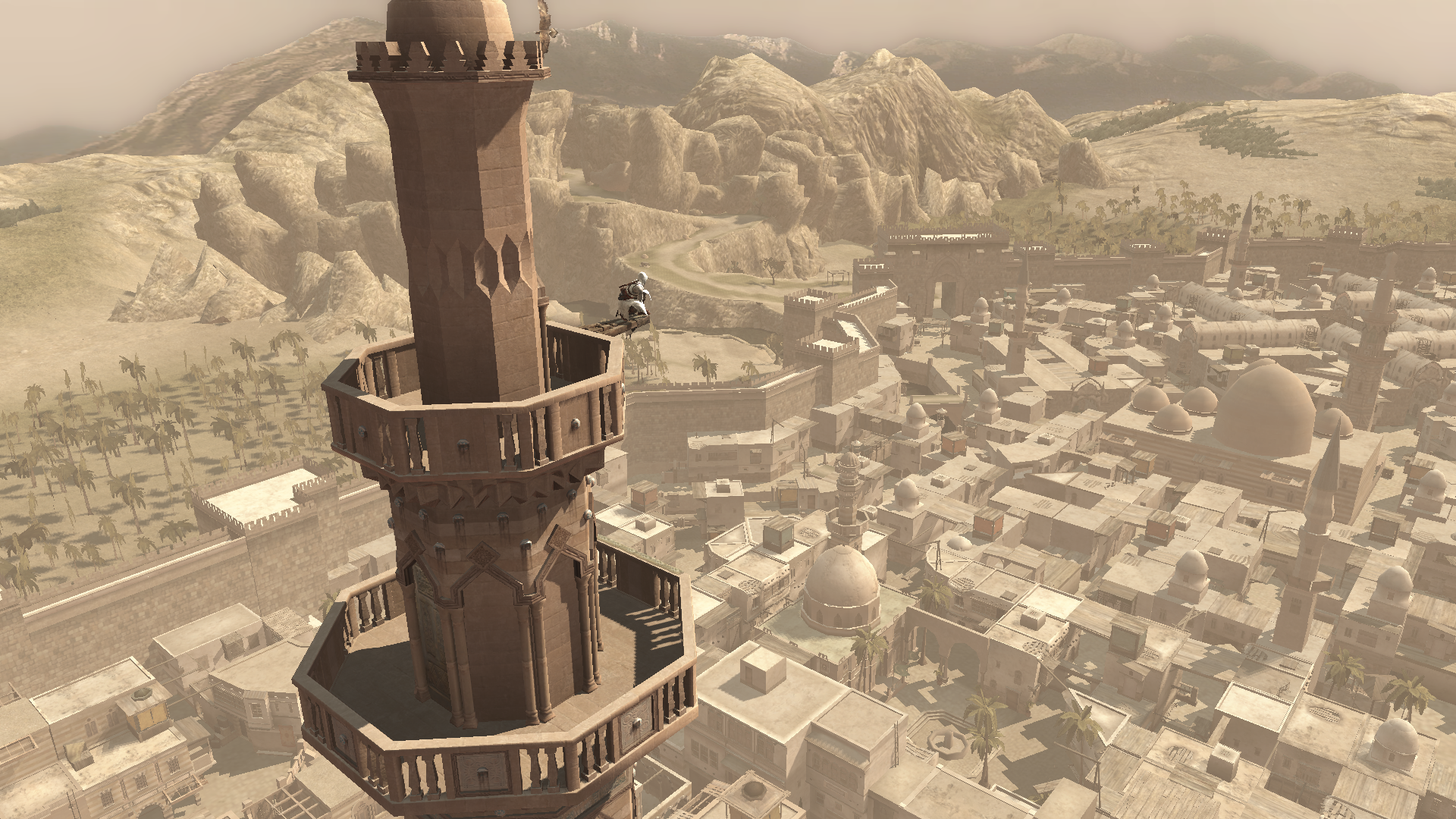

 Added by


